Faculty Research Areas

Dartmouth Chemistry Lab 1885
Organic Chemistry

A marine sea slug (nudibranch) loaded with natural organohalogen compounds as antifeedants.
Organic chemistry research at Dartmouth includes natural products, synthetic methods, medicinal chemistry, catalysis, organometallics, bioorganic chemistry, molecular machines, additive development and MOF sensors.
- Ivan Aprahamian - Molecular switches and machines, adaptive materials, fluorophores
- David S. Glueck - Homogeneous catalysis, asymmetric catalysis, sustainable energy
- Miguel I. Gonzalez - Solid-state photochemistry, heterogeneous catalysis
- Katherine Mirica - Synthesis of stimuli-responsive materials for deployment in mobile chemical sensors and microelectronic devices
- Jimmy Wu - Reaction methodology, alkaloid synthesis, heterocyclic chemistry
Biological/Biophysical Chemistry

The high resolution NMR structure of the C-terminus of the glutamate receptor with PDZ1 of the molecular scaffolding protein, SAP-90 (Dale Mierke).

Molecular Dynamics snapshot of the neurotransmitter GABA in a lipid bilayer (Robert Cantor).
Dartmouth researchers study the structure and function of biomolecules using NMR, laser spectroscopy, X-ray crystallography, calorimetry, synthesis, and computational methods.
- F. Jon Kull - Protein crystallography, molecular motors, cellular transport mechanisms, enzyme mechanisms
- Dale F. Mierke - Biophysical chemistry, high resolution NMR, peptide hormone structure and function
- Ekaterina V. Pletneva - Bioinorganic chemistry, redox reactivity and conformational dynamics of heme proteins
- Paul Robustelli - Molecular simulations and NMR spectroscopy to study dynamic and disordered proteins in atomic-detail, design and characterization of small molecule drugs that inhibit disordered proteins
- Michael J. Ragusa - Protein crystallography, small angle X-ray scattering, peripheral membrane proteins, autophagy
- Dean E. Wilcox - Bioinorganic chemistry, thermodynamics of metal-protein interactions, metalloenzymes, nitric oxide biochemistry
Materials Chemistry
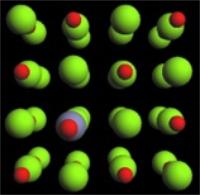
Structure of a magnesium zinc oxide surface (Joe BelBruno).
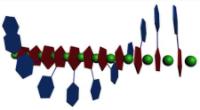
A helical molecular wire designed by Ivan Aprahamian.
Learn about our research on polymers, sensors, surfaces, molecular machines, and nanomaterials, which uses both experimental and theoretical techniques.
- Ivan Aprahamian - Molecular machines
- David S. Glueck - Homogeneous catalysis, asymmetric catalysis, sustainable energy
- Miguel I. Gonzalez - Porous materials and interfaces, heterogeneous catalysis, metal nanoparticles and nanoclusters
- Jane E. G. Lipson - Statistical mechanics of polymer melts, glasses, and blends. Theory and simulation applied to problems of blend behavior, and glassy thin films and mixtures
- Katherine Mirica - Synthesis of stimuli-responsive materials for deployment in mobile chemical sensors and microelectronic devices
- Xin Qi - Computational chemistry, multi-scale modeling, reaction modeling, nanocrystal growth and assembly
- Wenlin Zhang - Multi-scale simulations and statistical mechanics for polymers and soft matter
Inorganic Chemistry
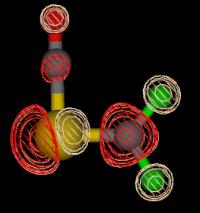
The π*-LUMO of the Ir-carbon double bond in a bis(trifluoromethyl)carbene complex of iridium (Russ Hughes)

Structure of a gold phosphido complex (David Glueck).
Dartmouth faculty specialize in bioinorganic and organometallic chemistry.
- David S. Glueck - Homogeneous catalysis, asymmetric catalysis, sustainable energy
- Miguel I. Gonzalez - Solid-state photochemistry, supramolecular coordination complexes, metal nanoclusters
- Ekaterina V. Pletneva - Bioinorganic chemistry, redox reactivity and conformational dynamics of heme proteins
- Dean E. Wilcox - Bioinorganic chemistry, thermodynamics of metal-protein interactions, metalloenzymes, nitric oxide biochemistry
Experimental and Theoretical Physical Chemistry

John Winn's apparatus for studying molecules trapped in solid hydrogen, a quantum solid.
Laser spectroscopy, NMR, statistical mechanics, quantum mechanics, and more.
- Jane E. G. Lipson - Statistical mechanics of polymer melts, glasses, and blends. Theory and simulation applied to problems of blend behavior, and glassy thin films and mixtures
- Dale F. Mierke - Biophysical chemistry, high resolution NMR, peptide hormone structure and function
- Ekaterina V. Pletneva - Bioinorganic chemistry, redox reactivity and conformational dynamics of heme proteins
- Xin Qi - Computational chemistry, multi-scale modeling, reaction modeling, nanocrystal growth and assembly
- Paul Robustelli - Molecular simulations and NMR spectroscopy to study dynamic and disordered proteins in atomic-detail, design and characterization of small molecule drugs that inhibit disordered proteins
- Mahima Sneha - Transient vibrational and electronic absorption spectroscopies, vibrational sum frequency generation spectroscopy, frequency generation spectroscopy, reaction mechanisms in photocatalysis, solution phase and interfacial chemistry
- Wenlin Zhang - Multi-scale simulations and statistical mechanics for polymers and soft matter